
One hundred days may seem like a long time or a very short one. That is dependent on usage. This is a CBSE board exam 2027 preparation plan that creates a definite roadmap for Class 10 and Class 12 so that you always know your today’s study and what will be your next study because board exam preparation is not about studying from 12 hours a day.
It’s completing the syllabus, doing the correct questions and revising in a lasting manner. Here are the easy phases of the 100 days.
Why a 100-Day Roadmap Works Better Than Random Studying
We have it in our education that most students do not struggle because they are not able. They struggle because their time doesn’t have any structure. They can’t stay focused on one topic or wait to do revision until it is too late.
A roadmap is a solution to this. There is one aim for each phase:
Complete Syllabus, Solve Old Papers, Practice Sample Papers, Mock Test and Revise. Progress can be monitored weekly and gaps can be identified and addressed early.
Start by Understanding the Marking Scheme
Find out how marks are awarded before writing your chapters. Go through the official cbse marking scheme and observe the division of marks into parts and types of questions.
Follow the class 10th CBSE marking scheme subject wise for class 10. In case of Class 12 do the same with the class 12 cbse marking scheme. Look for:
- How many marks each section carries
- Which chapters carry more weight
- How step marking works in maths, science, and numericals
- How detailed a long answer needs to be
Patterns can change, so always rely on the latest documents published on the official CBSE website.
Your 100-Day Plan at a Glance
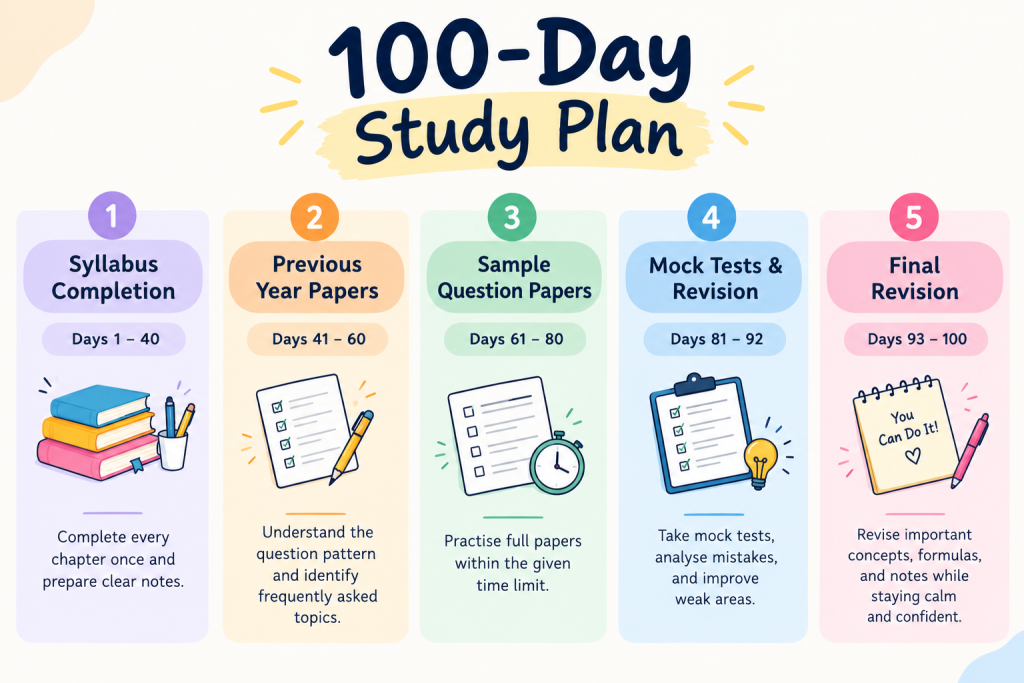
Days 1 to 40: Syllabus Completion
The first step is to make a list of all the chapters of all the subjects. Indicate strong, average, or weak.
The second step is to take longer with weaker and average chapters. Carefully read the NCERT, as most of questions are based on it. Create brief notes throughout: formulas, definitions, diagrams, and points of significance.
Establish goals for both the day and week. For instance, complete a certain amount of chapters every week, and then study them on the weekend. Don’t stop the plan, just change it for the next week if you aren’t able to catch up.
Days 41 to 60: Previous Year Papers (PYQs)
Next, from reading to practice. Solve previous year papers (chapter wise) first then (full papers). This will give you an idea of which topics are covered again and how the questions are worded.
When you are taking each question, circle the question when you miss it, circle the correct answer, and circle the explanation for the error. Was it a concept gap, a calculation slip or poor time management? This is a basic error analysis that you can use to help you revise later.
Days 61 to 80: Sample Question Papers (SQPs)
Sample papers come after PYQs as now you know the basics and the question style. Attempt official sample papers under the condition of an actual test. Spend time at a desk with a timer, and refrain from reading notes.
Compare your answers to the paper with the marking scheme after each paper. Review your mark scheme and identify the areas that you missed. Many times, you don’t know the answer, but the answer was not complete or it was poorly written. Write neat and coherent responses.
Days 81 to 92: Mock Tests and Spaced Revision
Complete a full mock test every 2-3 days. Revise errors in error notebook and weak chapters between the days.
Rewrite a topic after another day, after another few days, after another week. Include active recall as well: close your notes and attempt to remember and write them down without looking at your notes before verifying. It’s harder than re-reading, but it works better.
Days 93 to 100: Final Revision
Keep these last days light. Make any changes to short notes, key diagrams, formulas, and error notebook. Don’t attempt to learn new large subjects.
Do go to bed at your usual time and eat your meals at the right time and avoid judging how you are preparing against others. Answers are better written with a clear mind than a tired one.
Exam Strategy and Time Management
A few habits help every student:
- Study in focused blocks. Forty-five to sixty minutes of focused study, followed by a short break, works better than hours of distracted reading.
- Revise the same day. A ten-minute recap of what you studied helps memory.
- Plan your paper time. In mocks, practise dividing time across sections so you don’t run out in the last section.
- Rest properly. Keep one half day a week for rest or catching up.
For more general habits, these cbse board exam preparation tips apply to both classes and fit easily into the plan above.
Class 10 Subject-Wise Focus
For class 10, these cbse class 10 board exam preparation tips can be helpful. Take NCERT then sample papers. Practise steps in maths and not just answers. Carefully study diagrams and definitions in science. Make brief notes on maps and on timelines in social science. Ignore language papers – boost your overall score.
If the class 10 cbse board exam format looks unfamiliar, practice a few complete papers beforehand and they’ll become more familiar. Apart from these 10th board exam preparation tips, you can follow simple daily routine, revision and solve papers on a fixed schedule.
Class 12 Subject-Wise Focus
In Class 12, the emphasis is on depth because this class is important for college admissions. Use these cbse class 12 board exam preparation tips:: allocate more time to core subjects, work on numericals, case-based questions and long answers, take mock tests frequently. If you have an entrance exam to prepare for, then schedule your day so both of these receive their due.
Some useful 12th board exam preparation tips, which also work are: Memorize concepts rather than the words, and review the weakest chapters once a week.
Conclusion
A hundred days is enough to make a real difference if you use it with purpose. Finish the syllabus first, learn from previous year papers, practise with sample papers, test yourself with mocks, and revise calmly at the end.
Don’t wait for the perfect day to start. Pick your first chapter today and begin. Small, steady effort over 100 days builds the confidence you need on exam day.
FAQs
1. Is 100 days enough for CBSE board exams?
Yes, it can be, if you follow a clear plan and study regularly. Focus on the syllabus first, then practice and revision. Check the official CBSE website for the latest exam dates and notices.
2. How should I prepare for boards in 100 days?
Divide the time into phases: syllabus completion, previous year papers, sample papers, mock tests, and final revision. Set daily and weekly targets and track your progress.
3. How many hours should I study every day?
There is no fixed number. Quality matters more than hours. Study in focused blocks with short breaks, and keep time for sleep and rest.
4. Should I solve PYQs before sample papers?
Many students find it helpful. PYQs show you the question style and repeated topics, so sample papers feel easier later. Use the cbse marking scheme to check your answers in both.