
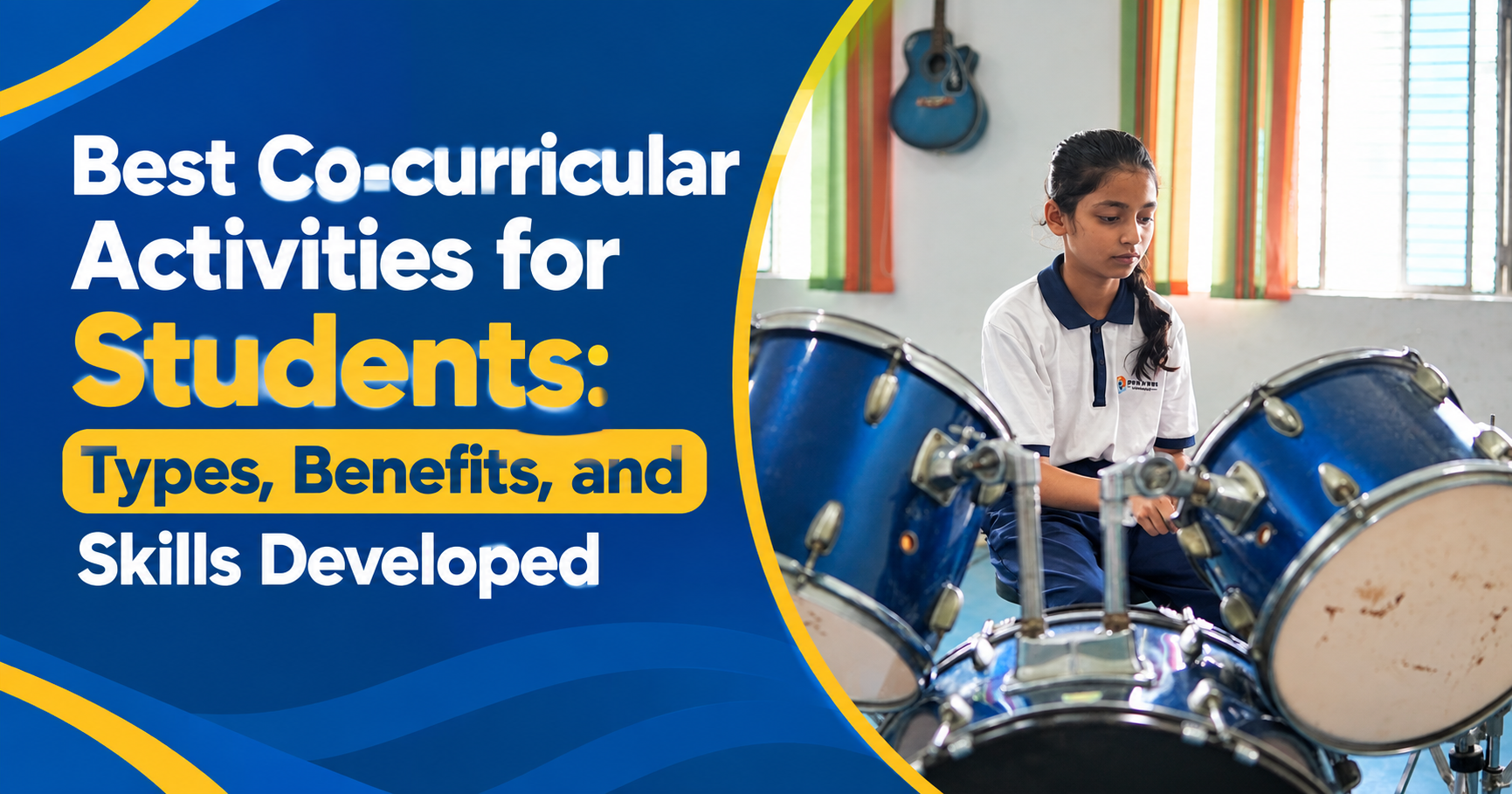
Think back to your school days. What do you remember the most? It’s probably not the chapters you studied for exams. You’re more likely to remember the debate you took part in, the play you performed in, the team you led, or the club you enjoyed being part of.
That’s what makes co-curricular activities special. They give students a chance to learn, explore their interests, and build skills beyond the classroom.
In this article, we’ll look at what co-curricular activities are, the different types students can take part in, and the skills they can help develop.
What Co-curricular Activities Actually Are
Co-curricular activities are conducted in parallel to regular curriculum that are closely linked to the regular curriculum, but outside regular class room arrangement. Debate club, science exhibitions, student council, school paper and all of this counts. They reinforce the in-class activity in another way.
This is a good opportunity to clarify the difference between co curricular and extra curricular activities as most use them interchangeably. They’re not quite the same. Co-curricular activities remain closely related to school subjects and objectives, such as a Maths olympiad team, a robotics club. A bit further out are the “extracurriculars”: the music, dance, sport, activities a student learns either largely through his or her own interest or curiosity, or because a teacher has chosen to teach it.
In real life, most schools just group extracurricular and co curricular activities together anyway, since both end up shaping a student in pretty similar ways, whatever the technical label.
The Different Types of Co-curricular Activities in School
Knowing the actual types of co curricular activities in school helps more than people expect. It makes it easier to spot where a particular student might genuinely find their thing.
Academic and Intellectual Activities
- Debate and public speaking clubs
- Quiz competitions and academic olympiads
- Science and math clubs, project exhibitions included
- Model United Nations and similar simulation programs
Creative and Performing Arts
- Drama and theatre societies
- Music, vocal or instrumental
- Dance and choreography clubs
- Art, painting, design clubs
Leadership and Community Focused Activities
- Student council and school parliament
- Community service and volunteering clubs
- Entrepreneurship or business clubs
- School magazine or journalism clubs
Technology and Innovation Activities
- Robotics and coding clubs
- Environmental and sustainability projects
- STEM based innovation challenges
Look at these co curricular activities examples and you’ll see how wide this really goes. There’s something here whether a kid is into ideas, performance, leading a group, or just building something with their hands.
The Best Co-curricular Activities for Students
The right pick always comes down to what a student actually enjoys, no way around that. But a handful keep coming up as some of the best co-curricular activities for students, mostly because of what they give back, confidence, real skill, doors that end up opening later.
- Debate and public speaking.
Builds the kind of confidence that carries straight into interviews and work meetings years later, arguing a point clearly, even under pressure.
- Student council or leadership roles.
Real accountability, and it starts early. Running an event, speaking for your peers, handling a disagreement without letting it blow up.
- Robotics and coding clubs.
Technical skill paired with genuine teamwork, which matters more now, given how much of work runs through technology these days.
- Theatre and drama.
A kind of confidence you can’t fake, standing in front of people and holding their attention, plus a specific brand of collaboration few other activities teach.
- Community service.
Builds empathy and a sense of responsibility that has nothing to do with personal achievement, something classrooms just don’t get to on their own.
Among the best extracurricular activities, sports deserve their own line here. Team sports especially teach discipline and resilience, plus something a lot of activities skip entirely, how to lose without falling apart, and how to win without turning insufferable about it.
Why These Activities Actually Matter
The importance of extra curricular activities isn’t just about keeping kids occupied once the bell rings. Students juggling academics alongside an activity tend to get better at managing their time, not because anyone lectured them about it, but because they simply have no other option. It builds social skills too, working alongside people whose strengths look nothing like your own, and it gives a student some sense of who they are beyond a grade or a test score, which matters for wellbeing more than most people give it credit for.
For college applications, and job applications later on, a profile with real, sustained co-curricular involvement, not a padded list thrown together for effect, tends to stand out more than academics alone ever could.
The Skills Students Actually Walk Away With
Worth getting specific here about the types of skills for students these activities actually build, instead of leaving it as some vague “it’s good for you” line.
- Communication skills, sharpened through debate, drama, or anything that puts you in front of people
- Leadership and teamwork, built through group projects, clubs, student council
- Problem solving, especially strong in robotics, coding, and innovation challenges
- Time management, which basically builds itself once you’re juggling schoolwork with practice or rehearsal
- Emotional resilience, from competition, performance, and learning to take a setback without it wrecking your whole week
A handful of skills examples for students make this less abstract. A debate club kid learning to structure an argument with the clock running out. A robotics student staying calm while a prototype just refuses to cooperate. A student council member learning to mediate a fight between two classmates without picking a side. None of this is soft or fuzzy, it’s built through repetition, the boring, unglamorous kind that nobody posts about.
What Schools Actually Need to Get Right
The strongest school co-curricular activities programs tend to share a few things. Real variety, not just one drama club and one sports team checking a box somewhere. Actual time carved into the weekly schedule, not whatever’s left over once academics are done. And staff or mentors who genuinely care, rather than treating it as something to fill space in a brochure.
Schools that get this right tend to see it themselves, students more engaged, more confident, and often stronger academically too, since the discipline built through co-curricular commitment has a way of bleeding into study habits as well.
Final Thoughts
Co-curricular activities aren’t a distraction from academics, whatever the old way of thinking assumed. They’re a real part of how a student grows into someone capable, someone that much more ready for whatever comes after school. Whether it’s a debate club, a robotics team, or a seat on the student council, the right activity builds things a classroom just can’t reach on its own, confidence, leadership, the ability to get back up after falling down, and to actually work well with people who see the world differently. Encouraging real, sustained involvement in even one or two of these, instead of academics alone, tends to shape a student in ways that outlast the marks by a long shot.
FAQs
1. How many co-curricular activities should a student participate in?
One or two, done properly, beat five done half-heartedly almost every time. Depth matters a lot more than a long list.
2. Do co-curricular activities affect academic performance negatively?
Not generally, not when it’s managed well. Most students juggling both actually end up with better time management and focus, mostly because they’re forced to prioritize.
3. What is the real difference between co-curricular and extracurricular activities?
Co-curricular activities stay tied to the academic curriculum and school goals, a science club or debate team, say. Extracurricular activities sit further out, hobbies like music or sport, pursued mostly out of personal interest.